what incentives does management have to overstate their loan loss reserve
Do Initial Claims Overstate Layoffs?
Initial claims for unemployment insurance averaged a stubbornly high 468,000 in the yr catastrophe December 2010, but take recently come down speedily. Many analysts interpret this as a sign that layoffs were also high to support a strong labor market recovery during nearly of 2010. Even so, claims information may have exaggerated layoffs in 2010 considering the fraction of unemployed workers applying for benefits was higher than earlier the recession. If the proportion of eligible workers who practical were held constant, 2010 claims would have averaged roughly 20% less than the actual reading.
The level of initial claims for unemployment insurance (UI) is a well-known leading indicator of labor market place conditions. Equally the economy weakens, businesses begin to lay off workers, causing initial claims for UI to rise. Conversely, as the labor marketplace begins to recover and layoffs subside, initial claims turn down (Gordon 2009). Consequently, weekly initial claims tend to provide a timely measure out of the strength or weakness of the labor market. During 2010, weekly claims averaged 468,000 nationwide, about lxx,000 higher than what would be considered normal at that stage of the business cycle. The persistent high level of initial claims suggested connected U.Southward. labor market weakness even as GDP was expanding.
This Economical Letter of the alphabet considers whether such a reading of initial claims data is accurate. Our inquiry is based on the fact that initial claims increase not only when more people get laid off, just also when the UI take-upward rate goes up. The have-up rate is the percentage of individuals eligible for unemployment insurance who claim and receive UI benefits. Thus, changes in the take-upwards rate get in harder to compare the level of initial claims over time. To begin to split up these ii effects, we construct an alternative measure out of initial claims that corrects for changes in the take-up rate. We guess the accept-up rate past using the U.Southward. Labor Section's Task Openings and Labor Turnover Survey (JOLTS). This survey provides a direct measure of layoffs and discharges in the economic system, thereby allowing us to infer the take-upwards rate.
We find that the take-up rate has increased significantly. During 2010, the average take-up rate was 37% higher than in 2007. This has acquired the initial claims information to exhibit an upward bias as a measure out of chore losses. Our alternative measure of initial claims, which corrects for the take-up rate, lies significantly below the official readings for 2010. When initial claims are adjusted for corrections in the have-up rate, the boilerplate level in starting time eleven months of 2010 was 386,000, non the official 468,000.
However, information technology is crucial to notation that the accept-up rate itself is an indicator of the health of the labor market. Information technology increases when the average duration of unemployment is loftier. And long-duration unemployment, of course, is an indication of poor task-finding prospects. Consequently, when we consider both UI claims and changes in the take-upward charge per unit, nosotros discover footling evidence that the labor marketplace was much stronger in 2010 than previously thought.
Two measures of layoffs
In the United States, the UI programme provides benefits to eligible workers who are unemployed through no mistake of their ain. These workers file a claim with a local unemployment office to start collecting benefits. Each local office reports the number of claims to the U.S. Department of Labor. Every Thursday, the department publishes the full of initial claims filed nationwide. Economists utilise the initial claims data to approximate the wellness of the labor market. The number of initial claims equals the number of layoffs times the fraction of laid-off workers eligible for unemployment insurance, known every bit the eligibility rate, times the fraction of these UI-eligible workers who file initial claims, known every bit the take-upwardly rate. If the eligibility charge per unit and the take-upward rate do not modify, then the initial claims number moves in direct proportion to layoffs. In this style, initial UI claims can be a good indicator of the extent of layoffs in the economy.
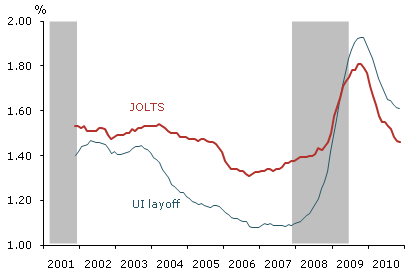
Figure 1
JOLTS and UI layoff rates (12-month moving average)
Source: Bureau of Labor Statistics (BLS), Department of Labor, and authors' calculations.
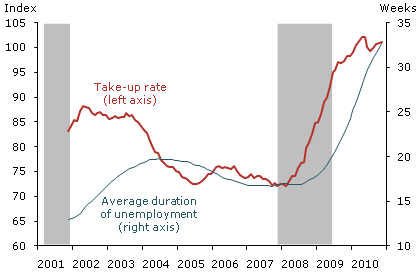
Figure 2
UI take-up charge per unit and average duration of unemployment (12-calendar month moving average)
Source: BLS and authors' calculations.
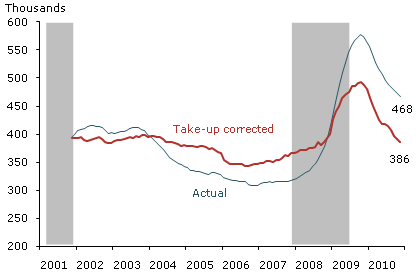
Figure 3
Bodily and take-up adjusted UI claims (12-month moving average)
Source: BLS and authors' calculations.
However, there is evidence that eligibility and take-upward take changed over fourth dimension. For instance, during the recent recession, the UI organization was expanded, assuasive many more workers to utilize for benefits. Moreover, UI participation increases during recessions as labor market conditions worsen (run across Cleary, Kwok, and Valletta 2009). During periods when unemployment duration is high, the take-up rate may increment because workers believe that their chances of lining upwardly jobs quickly are low.
To get a sense of how these factors take affected recent initial claims trends, we calculate two measures of layoffs, shown in Figure 1. The first is based on JOLTS data, which permit us to directly mensurate the fraction of workers who get laid off. The 2d is based on initial UI claims data, which allow us to measure the fraction of UI-eligible workers who file claims. Both measures move together, although the levels vary. During well-nigh of the sample period, the layoff measure based on UI claims lies below the JOLTS layoff measure. Withal, this has reversed in the past two years, which may reflect changes in the take-up charge per unit.
To back out the take-upwards rate, we need not only initial claims data, but also measures of layoffs and the eligibility charge per unit. To summate layoffs, nosotros utilize data from JOLTS. The apply of this survey is subject to a caveat. The data may understate the number of workers who lose their jobs because the survey tends to miss speedily shrinking establishments (Davis et al. 2008). The eligibility rate is the fraction of laid-off workers who qualify for UI. Figure ii plots the resulting take-up rate, indexed to 100 in June 2010. Figure two also includes the average elapsing of unemployment. It shows that the take-upwards rate increases when the labor market is weak and falls when the labor market is strong. Unemployed workers are more probable to file for UI if they look to be unemployed for long periods. In add-on, UI benefits were extended up to 99 weeks during the recent downturn, which gives unemployed workers additional incentive to file UI claims.
Accept-upwards adjusted unemployment insurance initial claims
Because of changes in the take-upwardly charge per unit, it is difficult to utilise levels of initial claims to assess the magnitude of chore losses, especially during the tardily stages of recessions. To have a consistent measure out over time, we right for changes in the take-up rate. In particular, nosotros summate the number of initial claims that would have occurred if the have-upwardly rate had stayed constant at its average from Dec 2001 to June 2010. Effigy three compares bodily initial claims and claims adapted for a constant have-up rate. The figure shows that adjusting the take-up charge per unit increases the initial claims measure when the labor market is strong and decreases it when the market place is weak. Both in 2001–2003 and 2008–2010, periods of recession or weak growth, initial claims adapted for take-up lie beneath actual claims. For the 2001–2003 menstruation, the difference between bodily and take-up adjusted UI claims is not very loftier. However, for the nigh recent downturn, the adjustment makes a big difference. The 12-month moving average of actual initial claims is 468,000, but the have-upwards adjusted average is 386,000. In other words, correcting for the take-up rate lowers the level of initial claims well-nigh 20%. Such an aligning brings the current level of initial claims closer to its pre-recession levels. As Figure 3 shows, the average take-up adjusted level of initial claims hovered around 350,000 in 2006.
Conclusion
Our assay suggests that the level of initial claims in 2010 reflected not only the level of layoffs, just likewise the increased reliance of laid-off workers on the UI organization, as measured by our calculation of a rising UI accept-up rate. This increase in the take-up rate reflects both the extension of UI benefits and an increased fraction of laid-off workers filing initial claims because their prospects of finding jobs were dim. Of class, these 2 factors are not easy to separate.
These findings imply that, equally long equally the UI have-upward rate remains loftier, initial claims readings will tend to stay loftier, even if layoffs fall to pre-recession levels. Moreover, recent declines in initial claims do non necessarily indicate a reduction in layoffs. Decreasing claims may also capture a decline in the accept-up charge per unit. We expect the take-up rate to turn down even more when both UI policy on length of benefits and elapsing of unemployment return to more normal levels.
References
Davis, Steven J., R. Jason Faberman, John C. Haltiwanger, and Ian Rucker. 2008. "Adjusted Estimates of Worker Flows and Job Openings in JOLTS." NBER Working Newspaper 14137.
Gordon, Robert J. 2009. "Green Shoot or Dead Twig: Can Unemployment Claims Predict the End of the American Recession?" VoxEU, May 1.
Cleary, Aisling, Joyce Kwok, and Rob Valletta. 2009. "New Highs in Unemployment Insurance Claims." FRBSF Economic Letter 2009-28.
Opinions expressed in FRBSF Economic Letter of the alphabet practise not necessarily reflect the views of the direction of the Federal Reserve Bank of San Francisco or of the Board of Governors of the Federal Reserve System. This publication is edited by Sam Zuckerman and Anita Todd. Permission to reprint must be obtained in writing.
buttonbefterriager.blogspot.com
Source: https://www.frbsf.org/economic-research/publications/economic-letter/2011/february/claims-layoffs-overstated/
0 Response to "what incentives does management have to overstate their loan loss reserve"
Post a Comment